
This is a practical summary of Daniel E. Ho and Olivia H. Martin’s article, “An AI Playground for the Courts,” highlighting why the legal sector urgently needs secure, zero-retention AI testing environments. The article was originally published by Lawfare on August 20, 2026.
- Frontier AI models now demonstrate remarkable proficiency in complex legal reasoning, successfully navigating Supreme Court hypotheticals and performing massive statutory surveys in a fraction of the time required by human clerks. However, these agents still suffer from high hallucination rates, sycophancy, and hidden biases. This creates a critical asymmetry: litigants are aggressively adopting advanced AI, while courts are stuck choosing between outright bans, consumer-grade personal accounts, or significantly underperforming legacy tools like Westlaw and LexisNexis.
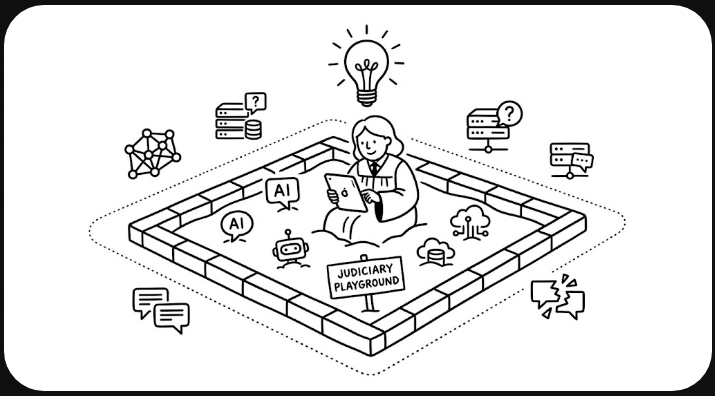
- To safely integrate generative AI, the authors advocate for a secure, judiciary-controlled “AI Playground.” This vendor-neutral sandbox would allow court personnel to test multiple frontier models side-by-side using public records. Governed by centrally negotiated enterprise agreements, this infrastructure ensures zero data retention, prevents judicial deliberations from being used for model training, and protects the courts from vendor lock-in or interface manipulation.
- For legal technology professionals, this shift underscores the necessity of building and deploying secure, sandbox-style testing environments to objectively evaluate capabilities across different LLMs. Relying solely on legacy research platforms is no longer sufficient; legal tech operators must pivot toward API-driven integrations that guarantee strict data sovereignty. Establishing secure, zero-retention frameworks for agentic workflows—whether for massive docket analysis or automated media rights reconciliation—is essential for maintaining a competitive and compliant edge in legal operations.
The authors argue the sandbox recommendation is realistic specifically because it avoids the prohibitive costs of custom, on-premise development.
Acknowledging that U.S. courts face IT staffing shortages and lack the budget to build specialized internal models (noting South Korea spent $7 million developing theirs), they propose a cloud-hosted sandbox as an affordable, near-term alternative. They point to Stanford University’s AI playground as a proof of concept, which serves nearly 40,000 users for tens of thousands of dollars per month and requires only one to two full-time engineers and part-time contractor support.
To implement these sandboxes, the authors recommend the following practical steps and tools:
- Adopt Open-Source Interfaces: Modify existing open-source platforms, such as LibreChat, to serve as the central user interface rather than building custom software from scratch.
- Utilize API Agreements for Frontier Models: Access top-tier models (e.g., from OpenAI, Anthropic, Google) through centrally negotiated enterprise or API agreements, allowing users to test multiple models side-by-side in one environment.
- Leverage Collective Acquisition: Negotiate these vendor agreements as a judiciary-wide system, rather than court-by-court, to secure volume discounts and enforce uniform privacy standards.
- Enforce Strict Contractual Guardrails: Ensure agreements mandate zero data retention, prohibit using inputs for model training, restrict vendor access to prompts, and ban account-level behavioral profiling.
- Start with Public Data: Initially restrict sandbox experimentation to public records and non-confidential tasks to mitigate risks while the courts build familiarity with the systems.
- Institute Shared Learning: Hold periodic knowledge-sharing sessions across chambers where judges and clerks can document effective workflows, prompt sensitivities, and unexpected AI failures.