Executive Education is becoming a significant path for assisting with the legal industry’s entry into adoption of artificial intelligence. I recently reported on a partnership between global law firm Reed Smith LLP and Cornell University in the establishment of an AI Leadership Program. Now, Stanford University announces that it is stepping into the moment with a new offering via its Executive Education department: A two-week, on-campus leadership program structured to enable participants to fully form strategies, governance and workflows around the use of artificial intelligence in the practice of law.
To fully understand the challenge and significance of these formal approaches to technology adoption (or rather “tech enablement”, to use modern phrasing) one needs to understand how previous efforts to engage lawyers in technology fared, historically. Pre-2023, the use of legal-specific tools, such as practice or matter management, was low: The Wolters Kluwer survey showed that in 2020, less than 39% of law firms would have considered themselves to be effectively leveraging technology. Notable roadblocks were the “billable hour,” and the learning curve for tools that that improved delivery of value, but minimized time-based effort.
The first watershed event was, initially, the Covid lockdown, which required lawyers to (finally) migrate toward cloud-based tools. Litigators who had previously resisted technology were mandated to use electronic court filings and document-generation and signature tools.
But artificial intelligence surpassed even that catalyst as a driver of technology in the practice of law. Statistics on AI use among attorneys varies wildly, with one credible survey indicating that more than 90% of lawyers saying they use at least one AI tool in their daily workflow.
The new challenge, then, is how, with this sudden rush to use AI do lawyers manage the sundry and complex concerns that have seemed to take a backseat to what is a hard-to-resist sugar coated confection. The main concerns for the average lawyer (and these are exponentially concerning to established law firms) are:
- Violations of client confidentiality
- Generative hallucinations
- Pricing pressures and devaluation of the billable hour
University-based executive education programs are now stepping into what is a gaping void. Simply buying, accessing and using the software is no longer the hurdle. ChatGPT, Grok, Claude, etc., require virtually no training to use, and the interface, rather than being a cluttered mess of tabs, records, and fields (well, clutter is what it seems like to a lawyer who hasn’t acclimated to the graphical grammar of software tools) is a simple chat box.
In the case of Stanford, the offering is known as the “Stanford Legal Engineering Academy,” which pitches itself as addressing the challenge that, “using an AI tool is not the same as understanding how to redesign and work around it.” Stanford Legal Engineering Academy emphasizes that “using an AI tool is not the same as understanding how to redesign work around it.” Their curriculum requires attorney-leaders to engage in hands-on building, prototyping, and developing actionable risk frameworks to safely redesign workflows. This directly counteracts the industry’s widespread “silent liability” issue, where attorneys secretly use unsanctioned consumer AI models because their firm hasn’t provided a safe, structured alternative
Props to Stanford for its use of the phrasing, “legal engineering,” a moniker which is in itself an innovation for a helter-skelter sector of business that has most commonly been referred to as “legal operations.” The latter, whose mainstay hub of activity is the staid professional networking group CLOC (Corporate Legal Operations Consortium), founded just ten years ago by Connie Brenton, Jeff Franke and Steph Corey, seems to attract and bestow laurels on those brave folks who evangelize for something hardier than Microsoft Word and Adobe Acrobat in the firms and departments where they labor.
By contrast, what Stanford, which is the North Star of global technology with its sundry schools and departments related to hard science engineering, seems to be communicating here, is, well, a hard science approach to an innovation that might be causing more havoc than productivity in the world of law. No one really knows, because we don’t het have the measurements of actual costs and benefits of time and resources that go into tossing a bunch of prompts into ChatGPT and Claude with the carelessness of a five-year-old throwing candy bars into a food blender.
Apart from the horror stories of hallucinated citations and other embarrassments that have plagued haphazard users of the tool, the use of lawyers — yours, mine, and everyone’s in between — is just another black box in the most hated profession.
Which makes these executive education programs absolutely crucial because it is within academia that forward-thinking approaches can be created, tested and iterated.
The profession does not need more AI tools nearly as much as it needs people who know how to redesign legal work around them—and “legal engineering” may finally be the right name for that job.
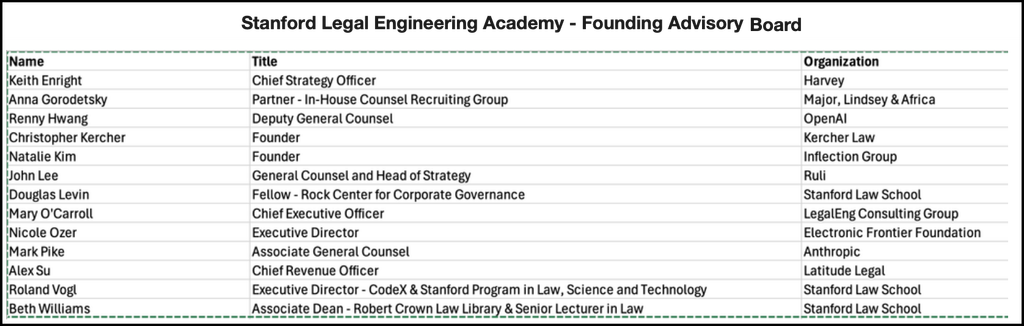
Below: Stanford has assembled an advisory board that reflects how broadly this problem now reaches across law firms, legal departments, technology companies and academia: